July 1, 1920

Some Kite-Balloon Experiments

Some Lessons of the Transatlantic Flight

Aeronautic Instruments

440441

Some Kite-Balloon Experiments

At the end of 1915 I was invited to compile and deliver a course of lectures on the Theory of Ballooning at the Royal Naval Air Station at Roehampton; and for the following three years I attended regularly at Roehampton, delivering two lectures daily and setting examinations for the officers under instructions to pass into the Airship Service and into the Kite-Balloon Service.

444445

Some Lessons of the Transatlantic Flight

One of the purposes of the transatlantic flight, and the reason the Navy Department backed it as a project and did all they could to make it go, was for the information that we were able to gain from such a flight. The planes were originally planned to go across in war time because there was not deck room or cargo space available to send big planes across.

436437

Aeronautic Instruments

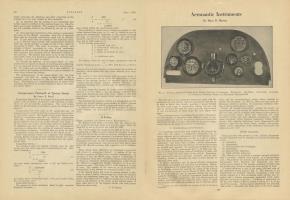
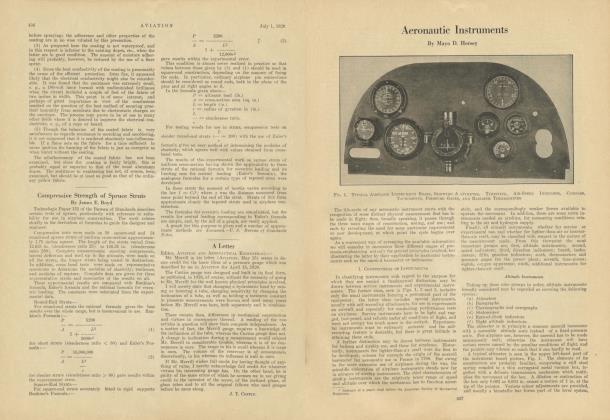
The life-cycle of any aeronautic instrument starts with the recognition of some distinct physical measurement that has to be made in flight; then, broadly speaking, it passes through the three main stages of construction, testing, and use; and ends by revealing the need for some particular improvement or new development, at which point the cycle begins over again.

434435

The Liability to Ignition of Balloon Fabrics

The tests here described were undertaken in order to obtain information in answer to the following questions:— (1) Whether the fabric sent (B. 29) is liable to become ignited owing to gunfire, and the result of a smoldering wad falling on it.

432433

The Dornier Giant Flying Boats

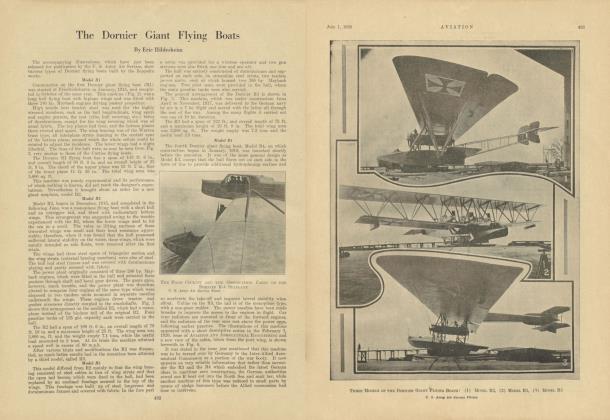
The accompanying illustrations, which have just been released for publication by the U. S. Army Air Service, show various types of Dornier flying boats built by the Zeppelin works. Model R1 Construction on the first Dornier giant flying boat (R1) was started at Friedrichshafen in January, 1915, and completed in October of the same year.

430431

Approximating Bending Moments in Air Propellers

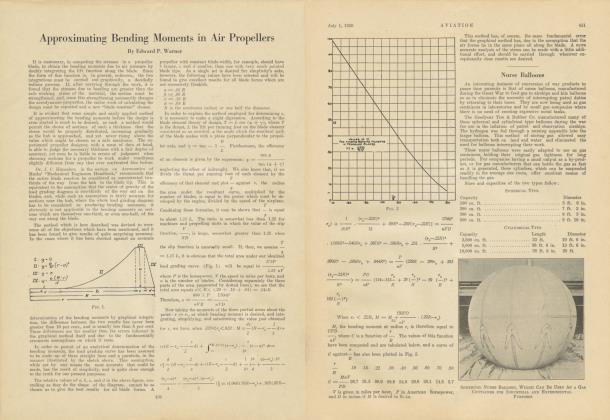
It is customary, in computing the stresses in a propeller blade, to obtain the bending moments due to air pressure by doubly integrating the lift function along the blade. Since the form of this function is, in general, unknown, the two integrations must be carried out graphically, a decidedly tedious process.

428429

Editorials

ONE of the greatest distinctions that may come to an aeronautical engineer is to be honored by a request from the Royal Aeronautical Society of Great Britain to deliver an address at the annual Wilbur Wright Memorial Lecture. The Wilbur Wright Memorial Lecture has been given annually since 1912, in which year a fund was raised by public subscription in England to perpetuate, by means of an annual lecture which would mark the state of aerial science, the memory of the great American pioneer.
440441

The Odier Portable Starter for Aircraft Engines

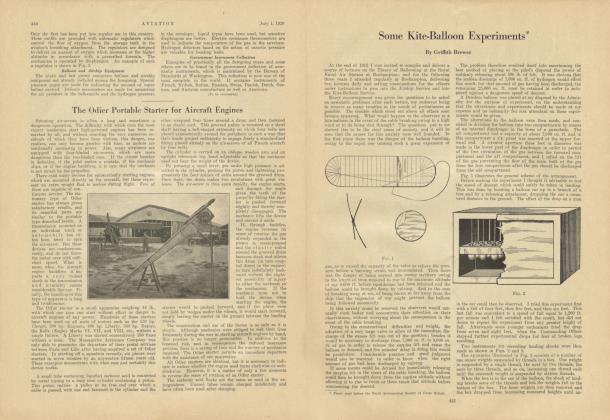
Spinning air-screws is often a long and sometimes a dangerous operation. The difficulty with which even the most expert mechanics start high-powered engines has been remarked by all, and without counting the very numerous accidents of which they have been victims, this danger, one realizes, can only become greater with time, as motors are continually increasing in power.
444445

N. A. C. A. Reports

THE KILN DRYING OF WOODS FOR AIRPLANES. Synopsis of Report No. 65, National Advisory Committee for Aeronautics. This publication is a brief discussion of all of the fundamentally important phases of the subject of kiln drying lumber specifically for use in airplanes.
434435

Air Mail Performance for May, 1920

The performance record of the Air Mail Service for the month of May, just issued, shows that 85 per cent of the trips between New York and Washington were completed in time; 86 per cent between New York and Cleveland; 65 per cent between Cleveland and Chicago; and 82 per cent between Chicago and Omaha.
JUNE 151920 JULY 151920