October 1, 1920

Safety in Flight

Development of German Aircraft Engines

Aluminum Alloys

154155

Safety in Flight

Other Materials Materials like plywood, glue and casein cements have also been gradually raised during the war from a condition of unreliable and irregular quality and placed on a more scientific basis. Thus the quality of glue has been improved by establishing definite test standards, and demanding the elimination of accidental and deleterious constituents.
164165

Development of German Aircraft Engines

When war broke out in 1914, the mean power of the aviation engines at the disposal of the German Air Force was 100 to 120 hp. on the ground. The unit weight of these engines, including the ater and oil contained in them, was from 1.8 to 2 kg. per hp.

156157

Aluminum Alloys

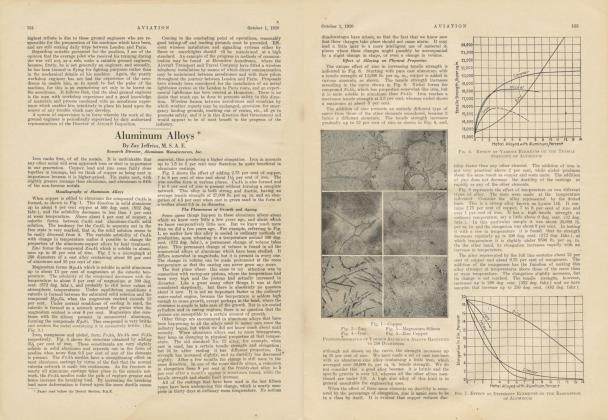
Iron ranks first, of all the metals. It is unthinkable that any other metal will even approach iron or steel in importance in our generation. Copper, lead and zinc come fairly close together in tonnage, but we think of copper as being next in importance because it is higher-priced.

160161

The Touring Airplane and the Variable Camber Wing

The demand for better service, or more usable qualities in airplanes is causing considerable thought on the part of many persons now engaged in the aviation industry. It presents to the designer and manufacturer a problem and to the inventor an opportunity or at least a hearing.

158159

Automotive Engineering Standardization and Progress

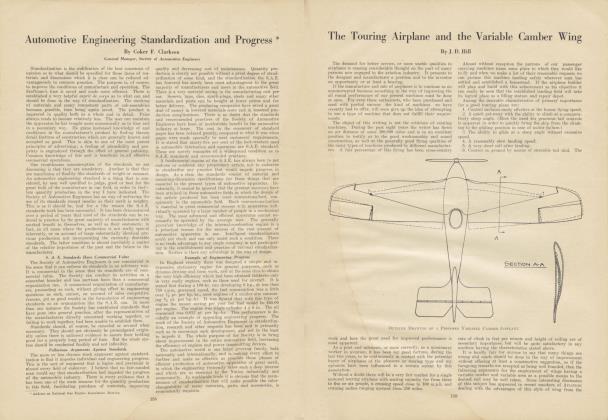
Standardization is the codification of the best consensus of opinion as to what should be specified for those items of materials and dimensions which it is clear can be reduced advantageously to common practice. The purpose is, of course, to improve the conditions of manufacture and operation.

146147

Editorials

MUCH of the improvement of airplanes has been directed toward the reduction of resistance, and consequently the gliding angle. That this is not an unmixed blessing has been found the case with racing machines, where an inordinately large field is required to land in.
148149

Gordon Bennett Entry of the U. S. Air Service

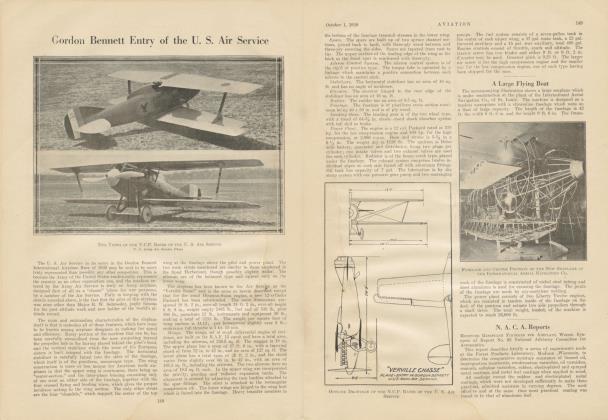
The U. S. Air Service in its entry in the Gordon Bennett International Airplane Race of 1920 may be said to be more truly represented than possibly any other competitor. This is because the Army of the United States traditionally represents the country as no other organiztion can, and the machine entered by the Army Air Service is truly an Army airplane, designed first of all as a “chasse” ’plane for war purposes, by a member of the Air Service.
156157

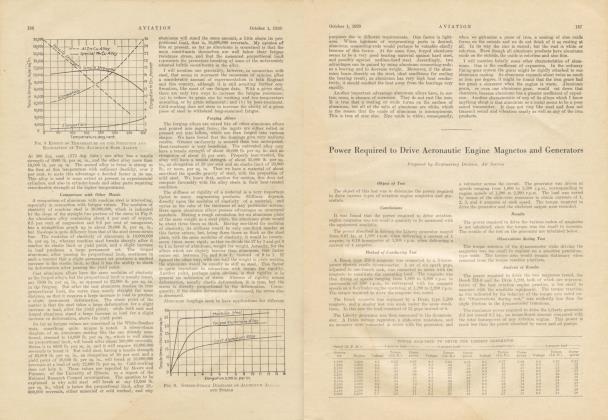
Power Required to Drive Aeronautic Engine Magnetos and Generators

Object of Test The object of this test was to determine the power required to drive various types of aviation engine magnetos and generators. Conclusions It was found that the power required to drive aviationengine magnetos was too small a quantity to be measured with the equipment available.
166167

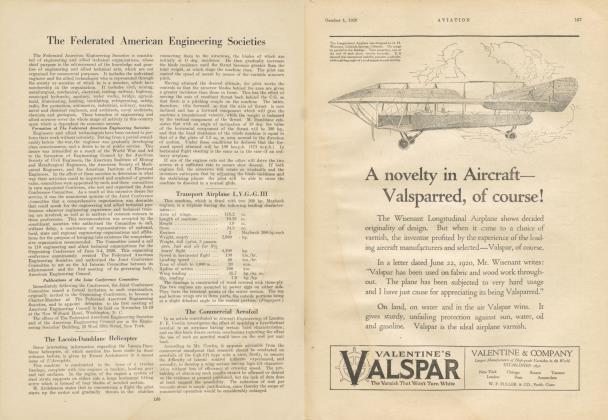
The Federated American Engineering Societies

The Federated American Engineering Societies is constituted of engineering and allied technical organizations, whose chief purpose is the advancement of the knowledge and practice of engineering and allied technical arts, which are not organized for commercial purposes.
166167

The Lacoin-Damblanc Helicopter

Some interesting information regarding the Lacoin-Damblanc helicopter, of which mention has been made in these columns before, is given by Ernest Archdeacon in a recent issue of L’Aerophile. This machine is constructed in the form of a tractor fuselage, complete with two engines in tandem, landing gear and tail surfaces.
SEPTEMBER 151920 OCTOBER 151920